
Somewhere in the endless spill of yellow sand between Phoenix and Tucson, we drove in silence, the roar of the long highway lulling me to sleep. With my head against the window, I was half-dreaming.
“Look!” My mother said, and I sat forward and saw the creature.
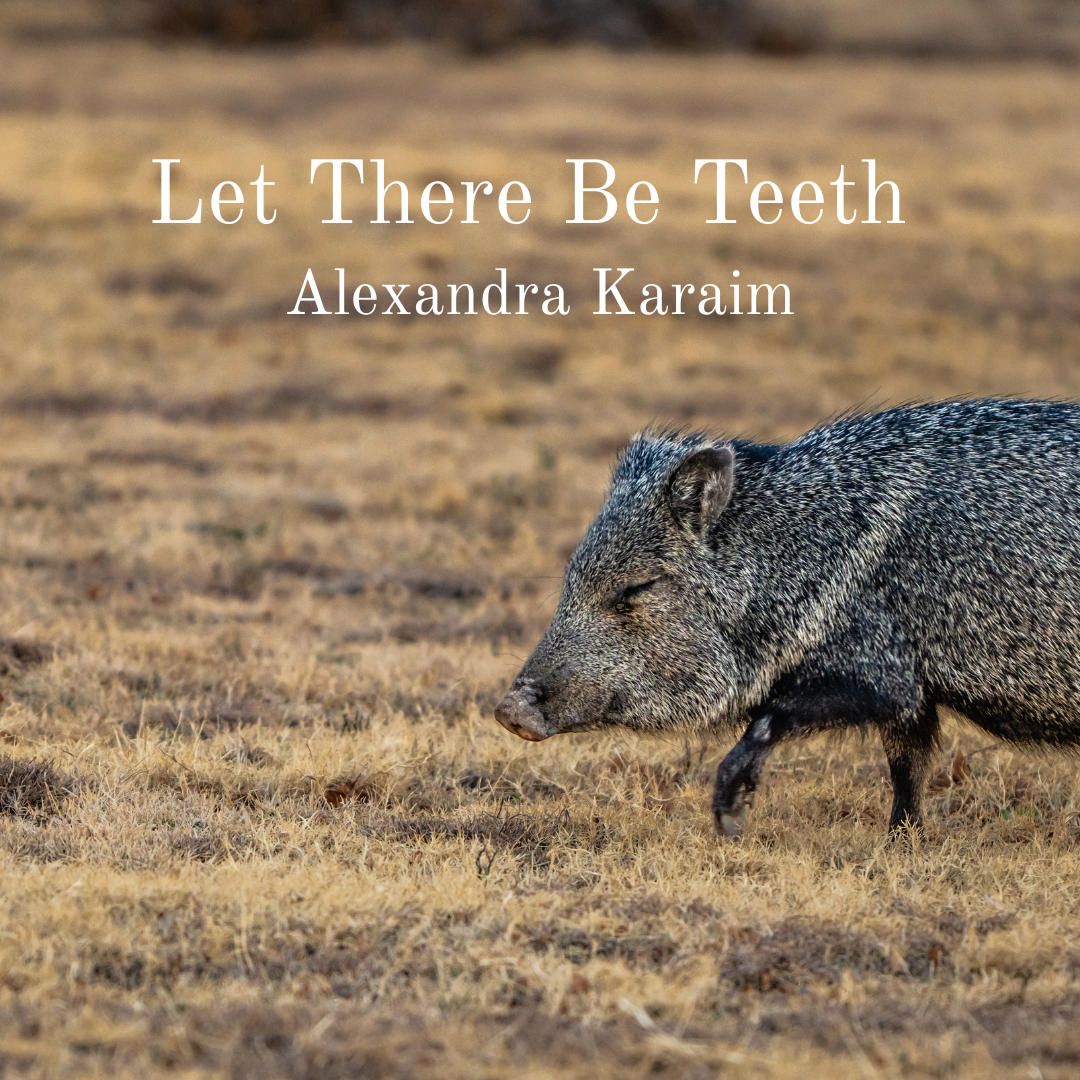
Brown and stout, he was a wild boar, a javelina, still far down the road as he lumbered across the asphalt. A truck whizzed by as he crossed between lanes. He was hurrying as if he knew the stakes. Then a gray car swerved in last-minute desperation and smacked the back of him and he fell flat onto the tarmac as we flew past.
In the rearview mirror, I saw him attempting to rise onto his short thin legs, then stumble again. And soon he had long disappeared behind us, his broken silhouette fading into a blip and then into nothing on the road which went back forever and ever among the mountains and the dust.
“Why did you wake me up?” I asked.
“I wanted you to see him,” she said. We hadn’t spoken since we saw him hit. She had her hands in their proper positions on the wheel, focused and quiet now though I knew we were both uneasy.
I understood it. There was a glory to him in those moments before he died.
My father and I went through her clothes, drawer by drawer and hanger by hanger, in a single night, just a few days after she was gone.
Piles made: things to donate, things to keep, things to go directly into the trash. She was sentimental and had old t-shirts from all sorts of events. She had an abundance of cozy socks and a million belts, brown black blue silver, none of which I thought were stylish. She had cardigans and dress shirts and pajamas and yoga pants. She had clothes we’d never seen her wear, and the closet was missing a dress of hers we remembered from a wedding. We thought maybe she’d brought it for dry cleaning, before she started to forget things, before everything started. We were numb and tired and performing a task. Life had reduced to a series of tasks, which were dwindling, and we weren’t sure what came after.
I assigned myself the jewelry box, which was satin red and filled with tangled strings of multicolored glass beads and earrings without their counterparts. Inherited things and flea market finds. I lifted the top level and sorted through what was beneath. A picture of herself, younger, topless and reclining in bed against the wall. I stared at it for a moment and felt how invasive and lonely it is to die.
I didn’t say anything to my father, though he was standing just across the room, and slid it back among the beads and knick knacks.
He left to tend to the dog or get fresh air or escape this moment. I went into the closet and lifted the pile of white envelopes from the inner and uppermost corner. I had feared them when I first spotted them, and I felt I should look at them while I was alone.
There were ten or fifteen of them, and they had an odd weight to them, their pale surfaces pockmarked by tiny items within. They weren’t love letters to my father or some other man. It was my own handwriting on their fronts.
Some had been opened but many had not. I slid one open along the top. My heart and the world were silent. At the bottom, as if crafted from porcelain, a tiny tooth, its hollow caked with decades-old blood. Light shining through the thin envelope, a milky cocoon, like it were in the womb. So so small, as to fit a mouth I couldn’t imagine ever being mine. Though it was, a speck of body, of bone, a bit of self which was lost through ordinary violence.
And the letter attached. Please give me more money than last time. Greedy opportunistic girl. Please give good luck to me and all my friends. I learned that one in church. A good thing to toss in while pleading for cash. I love you Amethyst. That was her name, the fairy, and she rode a little butterfly named Clementine. And I wrote them sometimes, even without an offering, and they wrote back, even then, enough free time on the job to visit a girl whose teeth were holding fast.
My mother was a writer, an inventor of magical worlds, a lover of animals, and, as it seems, sentimental down to every lost tooth. She would call me to the window to see a cardinal or a blue jay or even just a hummingbird at one of the several feeders she had set up in our backyard. She would wake me to see a javelina; she would have woken me to see a deer or a fox or a funny dog or a cloud shaped like a whale. She would wake me to see a javelina’s end. She would one day rise from bed off-balanced and flu-ish and with an inexplicable flashing in the outside corners of her eyes. She would be told she had an incurable brain tumor, a glioblastoma multiforme, and she would have it cut away once and then twice in the space of three months and then my father would call me from across the world and say there was nothing more to be done and I would fly home through the mid-Atlantic clouds in a state of waking nightmare. We wouldn’t tell her that. Like magicians or inventors, we would create hope. Like small pockets of air inside a flooded cave. We would come to believe in miracles when we had nothing left to believe in.
One day when she was home in hospice, it hailed giant golf-ball sized chunks of ice in the middle of July in the Arizona desert. And it was biblical and thunderous and they bounced off each other like pinballs in the dead sunburnt yard, and the dog hid under the dining room table and she slept in her metal hospital bed and I ran from front window to back window and said “Look at this, Mom!” to which she would never be able to answer.
And then weeks later, I opened each envelope and looked at each ivory tooth. I knew she had written back to every note. Amethyst the fairy wrote in my mother’s hand, but my belief in magic superseded my knowledge of penmanship. If only I’d kept the letters I received in return, though the love given is reflected in my correspondence. Thank you for your letter, Amethyst, like always. These strange flecks of bone as souvenir. The small mark of blood below the letterhead.
Later when I was living in Dublin, I once stayed in bed for hours, waiting for morning in Arizona so I could call her. (Probably more than once.) I had a boyfriend and I felt I’d developed feelings for another. Guilt-stricken, hungover, waking up in a state of fervent anxiety, all the way across the world, and I knew instantly who to call. “Ah,” she said, nearly chuckling although she always took me seriously. “And what are you going to do about it?”
She wrote a draft of a memoir once and I felt it was the saddest book I’d ever read. Small, grim shards of her life she’d kept hidden. Looking at her from across the car as she said “There is a place on this street with the nicest hot chocolate in the entire city” or “Maybe later this week we can go to L’Occitane and I’ll buy you a lotion if you find one you want,” I thought: How can you still be filled with this much love?
Driving away from the javelina as it was dead or dying, I wanted to cover her eyes and she wanted to cover mine. I feel the world is dark and the road is long, I could have told her. I know it is, she would’ve said. But think of all the magic.
Alexandra is a writer from Tucson, Arizona living in Dublin, Ireland. She holds an MA and MFA from University College Dublin. She has received the Agility Award from the Irish Arts Council, and the Ireland Chair of Poetry Student Award. She was a finalist for SmokeLong Quarterly’s 2022 Award for Flash Fiction. She was a contributing editor for the Belfield Literary Review, and has been published in New Word Order and SmokeLong Quarterly.